
Blackjack House Edge Calculator: What Rule Changes Cost
 Available in AU
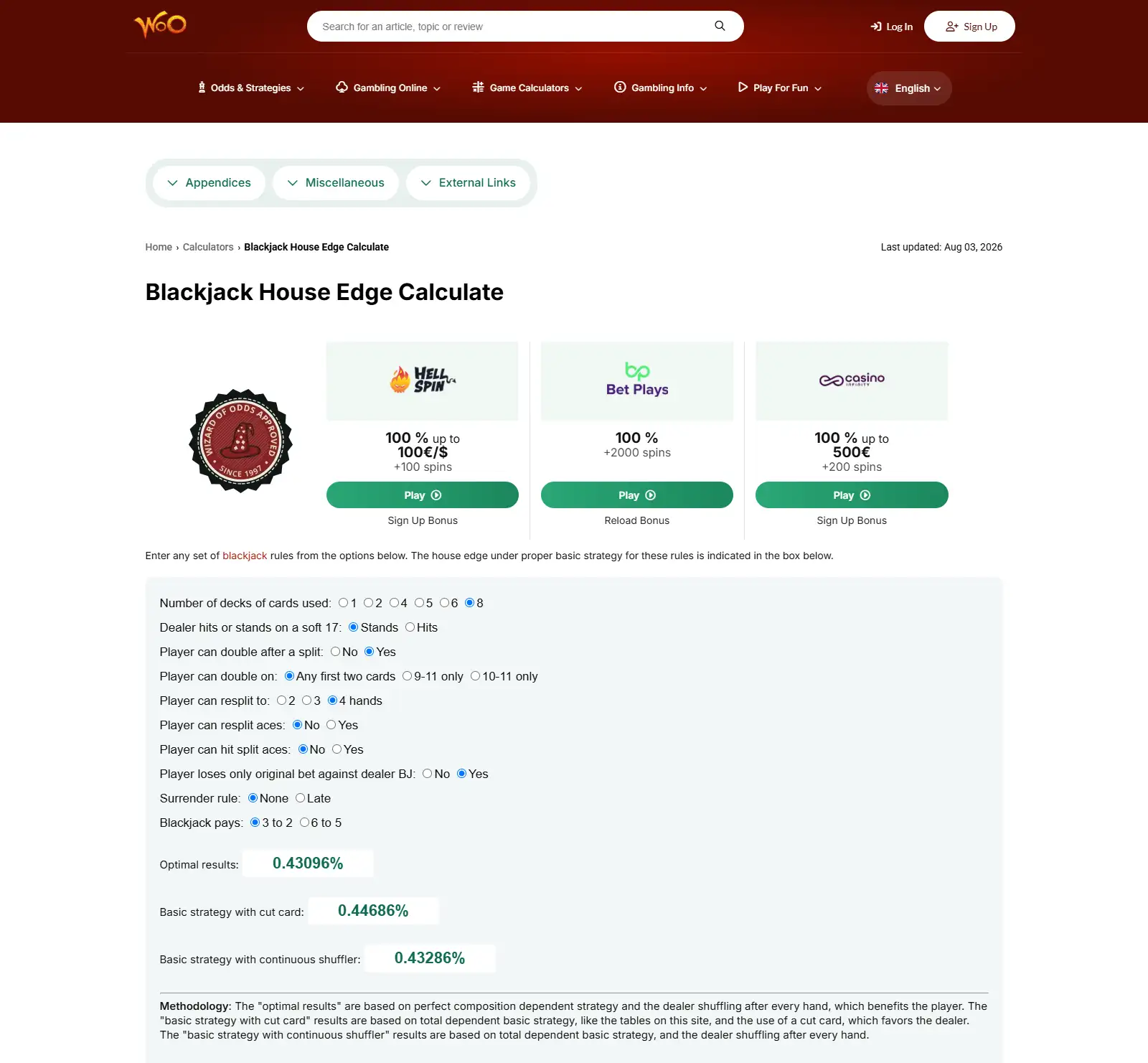
The Wizard of Odds blackjack house edge calculator is best understood as a rule-comparison tool. Blackjack does not have one universal house edge: the mathematical cost changes with the table rules and with the strategy assumed. Deck count, whether the dealer hits or stands on soft 17, doubling permissions, splitting rules, surrender and the blackjack payout can all change expected return. The useful question is therefore not simply “what is the house edge?” but “what does this exact rules package cost when compared with another one?” Wizard of Odds has deep blackjack coverage that includes rules, strategy and calculators, so this page focuses specifically on reading rule sensitivity rather than teaching a basic-strategy chart.
- House edge is a rules-package result
- Start with the blackjack payout
- Dealer soft 17 changes the baseline
- Doubling rules affect valuable opportunities
- Splitting rules are a bundle, not one switch
- Surrender can reduce the cost of weak situations
- Deck count matters, but never in isolation
- How to run a clean rule comparison
- What a lower house edge does – and does not – mean
- Keep the maths in perspective
- Related guides
House edge is a rules-package result
A house-edge percentage is a long-run expectation expressed relative to the amount initially wagered. It is not the casino’s guaranteed win on every hand, and it is not a forecast of your next session. In blackjack, the number is especially sensitive to rules because player choices interact with the dealer procedure and the available actions.
That is why comparing two blackjack tables by their headline game name is not enough. Two games can both be called blackjack while offering meaningfully different mathematical conditions. A calculator makes those differences easier to isolate: hold most settings constant, change one rule, and compare the resulting expectation. This one-change-at-a-time method is more informative than trying to memorise a single percentage.
The distinction also explains why a strategy calculator and a house-edge calculator answer different questions. The blackjack basic strategy calculator is about the preferred action for a hand under selected rules. A house-edge calculation is about the overall mathematical price of the rules package. The two ideas connect, but they should not be treated as interchangeable.
Start with the blackjack payout
The payout for a natural blackjack deserves early attention because it applies directly to one of the game’s strongest player outcomes. A less favourable payout reduces the value of receiving a natural. When comparing rules, record the payout before becoming distracted by smaller procedural differences.
This illustrates a broader lesson: a rule can matter even when it does not change what you click or say during ordinary hands. Payout rules affect the value of outcomes themselves. Action rules, by contrast, alter which decisions are available. A disciplined comparison separates those two categories and then considers the package as a whole.
Do not convert a payout difference into a promise about short-term results. A player can experience a winning session under worse rules or a losing session under better rules. The house-edge lens is about repeated exposure and expected value, not a guarantee for a particular visit.
Dealer soft 17 changes the baseline
A soft 17 is a dealer total of 17 that includes an ace counted as 11. A table may require the dealer to stand on soft 17 or to hit it. That procedural difference changes the dealer’s distribution of final outcomes and therefore changes the game’s expected value.
For comparison work, treat the soft-17 setting as a core rule rather than fine print. If two otherwise similar games differ here, keep the remaining inputs constant and examine the change. Then, if you are also studying how to play individual hands, make sure the strategy chart or calculator uses the same soft-17 assumption. Mixing a house-edge result from one rule set with a strategy table built for another undermines the comparison.
This is one reason the parent Wizard of Odds blackjack strategy emphasises rule sensitivity. Blackjack strategy is conditional: a compact slogan cannot replace the actual table conditions.
Doubling rules affect valuable opportunities
Doubling lets a player increase the stake in exchange for receiving one additional card. The mathematical value of that option depends on when it is permitted. A more restrictive doubling rule removes choices in situations where increasing the wager can otherwise be favourable.
When reading a calculator, distinguish between whether doubling is available generally and whether it remains available after splitting. These are separate rule dimensions. If a comparison changes both at once, you will know the combined effect but not which rule caused how much of the movement. For learning purposes, test them independently first.
The practical takeaway is not “double more” or “double less” in isolation. The correct action remains hand- and rule-dependent. The house-edge view asks what access to the option contributes across the full model, while basic strategy tells you when to use the option.
Splitting rules are a bundle, not one switch
Pair splitting can involve several conditions: how many hands may be created, whether re-splitting is permitted, what happens with aces, and whether doubled wagers are allowed after a split. These details can look minor because they occur only on some hands, yet they change the opportunity set available to the player.
A useful reading habit is to write the split conditions as a small checklist before comparing games. That prevents a vague label such as “splitting allowed” from hiding meaningful restrictions. It also helps when moving between a house-edge tool and a strategy reference, because the same assumptions should follow you into both.
For an educational comparison, the direction matters first: greater flexibility can have value when strategy uses it correctly. The exact numerical contribution belongs to the calculator result for the selected configuration rather than to a universal rule-of-thumb number.
Surrender can reduce the cost of weak situations
Surrender is an option to give up a hand under specified conditions and forfeit part rather than all of the original wager. Its value comes from avoiding the full expected cost of playing certain very weak situations to completion. Not every game offers it, and different forms of surrender are not equivalent.
From a house-edge perspective, the key point is that the presence or absence of a strategically useful option can change overall expected return. From a strategy perspective, the important question is whether the selected rule set permits surrender in the situation being analysed. Keep those levels separate: one is a game-level effect and the other is a hand-level decision.
If a table does not offer surrender, a strategy output that assumes surrender will not map cleanly to the real decision set. Rule matching is therefore part of using any calculator responsibly.
Deck count matters, but never in isolation
Blackjack is dealt from different numbers of decks, and deck count can affect probabilities and strategy. It is tempting to rank games by deck count alone, but that can be misleading because a game with one attractive rule may pair it with several less favourable conditions.
Use deck count as one input in a package comparison. First compare otherwise identical settings to understand its isolated effect. Then compare the actual packages you are studying. The second comparison is the one that represents the real trade-off.
This method is useful beyond blackjack. The casino house edge explained explains why expected-value comparisons work best when assumptions are explicit rather than compressed into a single label.
How to run a clean rule comparison
- Record the complete starting rule set before changing anything.
- Calculate or note the baseline result.
- Change one rule only, such as soft 17 or double after split.
- Compare the new result with the baseline and note the direction and size of the change.
- Restore the baseline before testing the next rule.
- Finally, compare the complete real-world rule packages rather than adding isolated effects casually.
This workflow avoids a common analytical error: changing several assumptions and then attributing the entire difference to whichever rule caught your attention. It also creates a reusable record of what each input means.
If you are studying session outcomes rather than game rules, move to the gambling session calculator. House edge is an input to long-run expectation; session variance is a different layer of the problem.
What a lower house edge does – and does not – mean
A lower house edge means a smaller negative expectation under the model’s assumptions. It does not mean a player is more likely to win every individual hand, nor does it remove variance. Short sequences can be dominated by card order and bet outcomes rather than by the small difference between two theoretical edges.
That distinction matters when differences are small. Mathematically, a better rules package is still better, but a short session may provide no visible evidence of that advantage. Expected value becomes informative through repeated wagering, while variance describes how widely actual results can move around expectation.
For decision-making, use house edge to understand price, basic strategy to understand actions, and session mathematics to understand dispersion. Keeping those jobs separate makes the Wizard of Odds calculator ecosystem easier to interpret without turning any single metric into a prediction.
Keep the maths in perspective
Strategy and house-edge calculations describe mathematical expectations. They do not turn a negative-expectation casino game into a guaranteed source of profit, and they do not predict what will happen in one session. For Australian readers, this guide is educational and does not recommend signing up with or depositing at an online casino.
Related guides
- Wizard of Odds Australia
- Wizard of Odds blackjack strategy
- blackjack basic strategy calculator
- house edge and expected value
- gambling session calculator
The full picture is in the Wizard of Odds guide for Australia.
What the number means in general: house edge and expected value.
Created by the ”Wizard Of Odds” editorial team.